February 3, 2026

The FCC Ban is Forcing the U.S. Drone Market to Grow Up

Author

Mariah Scott, CEO

Share

Accelerating a transition that was already underway.

The FCC’s recent action on new foreign-made drones and components has been widely described as disruptive. That’s true. 


But from an investor lens, the more important point is this: it accelerates a transition that was already underway. And, makes the path forward clearer. 


The U.S. commercial drone industry is being forced to decide what it wants to become. 


The question investors should ask 

The question is not whether demand exists. Commercial demand is already real: agriculture, utilities, infrastructure, public safety, environmental monitoring. 


The question is whether the U.S. market grows as: 


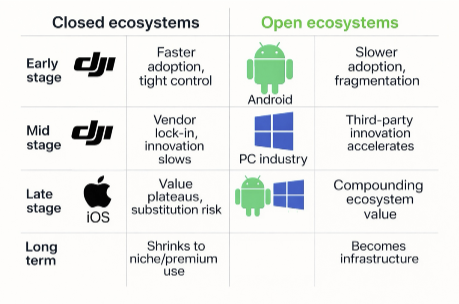
  • a fragile set of closed stacks that require enormous capital and ongoing support expense to replicate and manage end-to-end, or 
  • a durable ecosystem where specialized companies build at the right layers and compound innovation downstream. 

Those two outcomes produce very different investment dynamics. 


Why “everyone must be Apple” is an expensive bet 

Many investors naturally gravitate toward vertical integration. It feels defensible: own the hardware, own the software, control the whole experience. 


In practice, that's the most expensive way to build a market. 


When every manufacturer believes they must recreate the entire stack — aircraft, components, compute, software, data, compliance, workflows — the industry duplicates massive R&D effort. Timelines slip. Prices rise. Adoption slows. The end user loses. 


This is especially acute in commercial drones because affordability matters. Drones are tools. Farmers, utility crews, inspectors, and first responders buy drones because they reduc risk, saves time, and integrate with the rest of their work. 


An industry that requires every OEM to become a fully integrated software company will produce fewer viable manufacturers and higher prices for operators. 


Why drones behave more like computers than autonomous mobile robots 

A common argument against an “ecosystem model” is that robots require highly customized software, tightly matched to hardware. That is true in many robotics categories. 


Commercial drones are different. 


Drones are closer to standardized platforms with payload variation and workflow variation. The airframe and payload matter, but the operational workflows matter just as much: job planning, compliance, logging, maintenance, data management, reporting, integrations, and multi-site fleet operations. 


That’s why the computer analogy keeps coming up. 


Computing scaled when specialized companies competed at the right layers — components, hardware assembly, operating systems, applications. That ecosystem produced many winners and ultimately built the market faster than any single vertically integrated approach could have. 


The same basic logic applies here. 


Where the government focus helps, and where it doesn’t 


The U.S. government is clearly pushing to build domestic supply chains, primarily through defense initiatives. That can be a jumpstart for components and manufacturing. 


But commercial drone operations have fundamentally different requirements than the “attritable” systems currently being sourced by these government initiatives. 


Commercial operators need: 


  • durability 
  • reliability 
  • usability 
  • supportability 
  • repeatable workflows 
  • software that makes the drone a tool, not a project 

A market that tells commercial users to “wait a few years” isn’t aligned with reality. Demand exists now, and the work will be done by whoever can serve operators with practical, repeatable systems. 


So what’s the investable opportunity? 

Open ecosystems aren’t “give it away for free.” They’re a different value-creation model. A durable U.S. drone ecosystem creates multiple points of value: 


  • aircraft manufacturers specialize in reliable performance 
  • component and sensor companies fill critical gaps 
  • software and data platforms become shared infrastructure that accelerates time-to-market 
  • operators benefit from choice, competitive pricing, and fast iteration 

That structure doesn’t just create one winner. It creates a category with many winners — and a larger market. 


Where American Autonomy fits 


At American Autonomy, Inc., we’ve built for this environment: U.S.-built, secured, and hosted software that is interoperable and hardware-agnostic by design. 


We believe core capabilities, including mission planning, data management, compliance infrastructure, operator workflows, can and should be shared across manufacturers. That reduces duplication, lowers costs, and allows OEMs to focus investment on aircraft performance and differentiated hardware. 


The FCC’s action didn’t end innovation. It made the industry’s next chapter inevitable. 


Now the question becomes: do we build an ecosystem that compounds, or closed stacks that fragment? 


For investors looking at timing: this is a market that is shifting from possibility to structure. And structure is where durable value gets created.


By Mariah Scott, CEO January 14, 2026
The FCC’s recent action has prompted a lot of discussion about risk in the U.S. drone market. I see something else as well: a compelling opportunity to build a more durable, investable ecosystem. Historically, closed, vertically integrated systems can scale quickly (with a LOT of investment), but open ecosystems create far more value over time. Most importantly, they invite competition. They also attract specialized builders and compound innovation downstream. That structure is good engineering AND good economics. And it aligns with something uniquely American. Our most enduring technology advantages have not come from closed monopolies. They’ve come from open systems that have allowed thousands of companies to participate and specialize. The result was scale, resilience, and global leadership. For drones, this matters. Civilian drone markets are not single-product markets. They are ecosystems serving agriculture, energy, infrastructure, public safety, and environmental monitoring. Each of those verticals can benefit from shared software, interoperable data, and modular hardware rather than multiple companies investing heavily trying to lock in users and own everything end to end. An open U.S. drone ecosystem creates multiple points of value creation: Aircraft manufacturers focus on reliability and performance. Software companies build platforms that connect drones into real operational workflows. Sensor and imaging companies specialize in precision data collection. Operators benefit from choice, competition, and faster iteration. At American Autonomy, we’ve bet on this model. Our software is built in the U.S., hardware-agnostic by design, and intended to be shared infrastructure rather than a control point. That approach may feel slower at first, but history suggests it is the better long-term investment. The question for investors is not whether the U.S. drone industry grows. It is whether it grows as a fragile stack or as a durable ecosystem. I believe the second outcome creates far more value for everyone involved.